

Entering a partnership is one of the most exciting steps an entrepreneur can take. Whether you’re launching a consulting business with a friend, building a real estate investment group, or forming a professional practice, partnerships allow multiple people to combine skills, resources, and experience. But while partnerships offer flexibility and low start-up costs, they also carry unique legal and financial risks.
This is why a written Alberta partnership agreement is essential. Even though Alberta law does not require partners to have one, a formal agreement protects your business, clarifies each partner’s responsibilities, prevents disputes, and supports long-term stability – especially when you’re preparing to register a Partnership in Alberta.
In this complete guide, we break down the key elements every Alberta partnership agreement must include, why it matters, how it differs between GP, LP, and LLP structures, and how it supports your business registration. You’ll also learn why Business Alberta Online is the most reliable platform for registering partnerships in Alberta in 2025.
What Is a Partnership Agreement in Alberta?
A partnership agreement is a legally binding contract between two or more individuals (or corporations) who agree to operate a business together with the intention of earning a profit. It outlines how the partnership functions, how decisions are made, and how profits and responsibilities are shared.
While Alberta’s Partnership Act sets out default rules for partnerships, these rules may not reflect what partners truly want. A written agreement allows partners to define their own terms, giving them full control over how the business operates.
A partnership agreement is especially important because:
- Partnerships have shared liability (GP), mixed liability (LP), or limited liability (LLP).
- Verbal agreements often lead to misunderstandings.
- Without a written agreement, default laws may be applied during disputes.
- Your business reputation, finances, and legal obligations can be affected by your partner’s actions.
A partnership agreement is not just a document – it is the foundation of trust and stability for your business.
Why Every Alberta Partnership Needs a Written Agreement
Even among friends, family members, or long-time business colleagues, misunderstandings can occur. A partnership agreement protects everyone involved by providing clarity and structure.
1. Prevents Disputes Before They Happen
Clear expectations reduce conflicts over money, roles, or responsibilities.
2. Protects Personal and Business Assets
Knowing who is liable for what helps avoid devastating financial consequences.
3. Establishes a Smooth Process for Decision-Making
Helps avoid deadlocks when partners disagree.
4. Ensures Long-Term Stability
A written agreement gives the business continuity if a partner leaves or passes away.
5. Creates Legal Clarity for Banks, Clients & Government Agencies
A partnership agreement adds credibility and supports your business registration.
6. Supports Compliance When You Register a Partnership in Alberta
While the partnership registration certifies your business name and partners, the agreement explains how your partnership actually functions.
In Alberta, many failed partnerships could have been avoided with a properly written agreement.
Alberta Partnership Agreement Essentials: Key Clauses You Must Include
A strong partnership agreement protects your business, reduces liability, and ensures smooth collaboration. Here are the essential clauses your Alberta partnership agreement must include.
1. Partner Roles & Responsibilities
This section defines what each partner does and how they contribute to the business.
Include:
- Operational duties
- Leadership roles
- Decision-making authority
- Areas of oversight (finance, marketing, HR, operations)
Clear roles prevent overlap, confusion, and resentment.
2. Capital Contributions
Specify each partner’s investment:
- Cash contributions
- Property or asset contributions
- Tools, equipment, or intellectual property
- Time-based contributions (sweat equity)
This section ensures fair recognition of each partner’s input.
3. Ownership Percentages
Ownership is often tied to contribution, but can also be based on agreement.
The partnership agreement must clearly define:
- Ownership structure
- Equity percentages
- Voting power
This prevents future legal battles over control and entitlement.
4. Profit & Loss Distribution
In Alberta partnerships, partners can divide profits however they agree – 50/50, proportional, or performance-based.
Your agreement should define:
- How profits are calculated
- When partners receive distributions
- Whether profits stay in the business or are withdrawn
You should also outline how losses are shared to avoid misunderstandings during financial downturns.
5. Decision-Making Rules
Partnerships can fall apart when disagreements arise.
Your agreement should specify:
- What decisions require a majority vote
- What decisions require unanimous approval
- Tie-breaking rules
- Emergency decision protocols
Strong decision-making rules help your business function smoothly under pressure.
6. Management Duties & Authority
Define:
- Who manages daily operations
- Who oversees finances
- Who handles client relations
- Who hires staff
- Who signs contracts
This prevents partners from unintentionally undermining each other.
7. Adding or Removing Partners
Partnership compositions change over time. Your agreement should include:
- Admission process for new partners
- Buy-in requirements
- Removal process for non-performing partners
- Rules for partner expulsion
- Non-compete or confidentiality clauses
This protects the partnership’s integrity.
8. Dispute Resolution Clause
This clause outlines how disagreements will be resolved. Options include:
- Mediation
- Arbitration
- Voting
- Third-party review
A dispute-resolution clause protects your business from costly legal battles.
9. Withdrawal, Retirement, or Death of a Partner
Life happens. Your agreement must cover:
- Buyout procedures
- Transferring ownership to new or existing partners
- Handling inherited partnership interests
- Partnership continuation or dissolution
These terms protect the business during major transitions.
10. Dissolution of the Partnership
If the partnership must end, your agreement should outline:
- How the remaining assets are divided
- How debts are handled
- How clients and employees are informed
- Legal filing requirements under Alberta law
A structured dissolution clause prevents chaos during closure.
Partnership Agreement Requirements by Partnership Type
Different partnership structures require different agreement details.
General Partnership (GP)
GPs require the most clarity because all partners share liability.
Include:
- Liability sharing terms
- Equal vs unequal management authority
Financial responsibility roles
Limited Partnership (LP)
LPs must differentiate between:
- General partners (unlimited liability, operational control)
- Limited partners (limited liability, investor role)
Your agreement must outline:
- Limited partner contribution limits
- Restrictions on limited partner involvement
- Distribution rules
- Protection clauses
Limited Liability Partnership (LLP)
LLPs are used by regulated professions. Agreements must include:
- Liability protection rules
- Professional compliance requirements
- Insurance requirements
- Professional misconduct clauses
LLP agreements typically require regulatory approval.
Partnership Agreement vs. Partnership Registration: What’s the Difference?
Many entrepreneurs confuse these two concepts, but they serve different purposes.
Partnership Registration
- Makes your partnership legally recognized in Alberta
- Records your partnership name and partner information
- Required by banks and government agencies
Partnership Agreement
- Governs how your partnership operates
- Protects partners from disputes
- Defines financial and legal responsibilities
You need both for a stable, legally compliant partnership.
How a Partnership Agreement Supports Alberta Partnership Registration
Partnership agreements make registration and operation smoother by:
- Providing formal documentation for banks
- Supporting CRA account setup
- Establishing ownership percentages
- Creating clarity for licensing offices
- Supporting long-term compliance
Having an agreement before registering ensures your partnership starts on solid foundations.
Do You Need a Lawyer to Create a Partnership Agreement?
Not necessarily – but in some cases, it’s highly recommended.
You can create your own agreement if:
- Your business is small
- Your partnership is simple
- All partners understand and agree to the terms
You should hire a lawyer if:
- It’s an LLP
- You have outside investors
- There is substantial liability risk
- You’re unsure about legal language
A lawyer helps ensure compliance with Alberta’s Partnership Act.
Common Mistakes Alberta Entrepreneurs Make in Partnership Agreements
Avoid these pitfalls:
- Not putting anything in writing
- Assuming equal contributions when they are not
- Forgetting dispute-resolution procedures
- Not planning for partner exits
- Not updating the agreement as the business grows
- Mixing personal and business finances
A well-written agreement prevents these costly mistakes.
Why Business Alberta Online Is the Best Platform to Register a Partnership in Alberta
Registering your partnership is the first legal step toward operating your business.
Business Alberta Online makes this process simple, fast, and reliable.
Alberta-Focused Expertise: Built specifically for Alberta entrepreneurs and Alberta Corporate Registry requirements.
Fast & Accurate Registration: Your partnership registration is processed quickly and correctly the first time.
Secure Online Submission: Your data is protected with industry-standard encryption.
Accepted by Banks & Licensing Authorities: Documents are compliant and easily recognized by financial and government institutions.
Clear, Transparent Pricing: No hidden fees. No confusing add-ons.
Ideal for GP, LP, and LLP Partnerships: Perfect for small businesses, professional practices, real estate groups, and investors.
Complete Your Partnership Registration Through Business Alberta Online
Frequently Asked Questions About Partnership Agreements in Alberta
1. Is a partnership agreement required by law in Alberta?
No, but it is highly recommended.
2. Can a partnership agreement be changed later?
Yes—partners can update it anytime with mutual consent.
3. Are partnership agreements legally binding?
Yes, they are enforceable contracts.
4. Do limited partnerships require special clauses?
Yes, especially regarding limited partner involvement and liability limits.
5. Can family members form a partnership in Alberta?
Absolutely—family partnerships are common.
6. Does a partnership dissolve when a partner leaves?
Only if the agreement doesn’t outline continuation procedures.
7. Do partnerships need annual government filings?
General and limited partnerships do not; LLPs may require updates via their regulatory body.
An Alberta partnership agreement is more than paperwork—it is the foundation of a healthy, stable, and legally compliant business relationship. By outlining partner roles, contributions, responsibilities, and exit strategies, your agreement protects both the business and the individuals behind it.
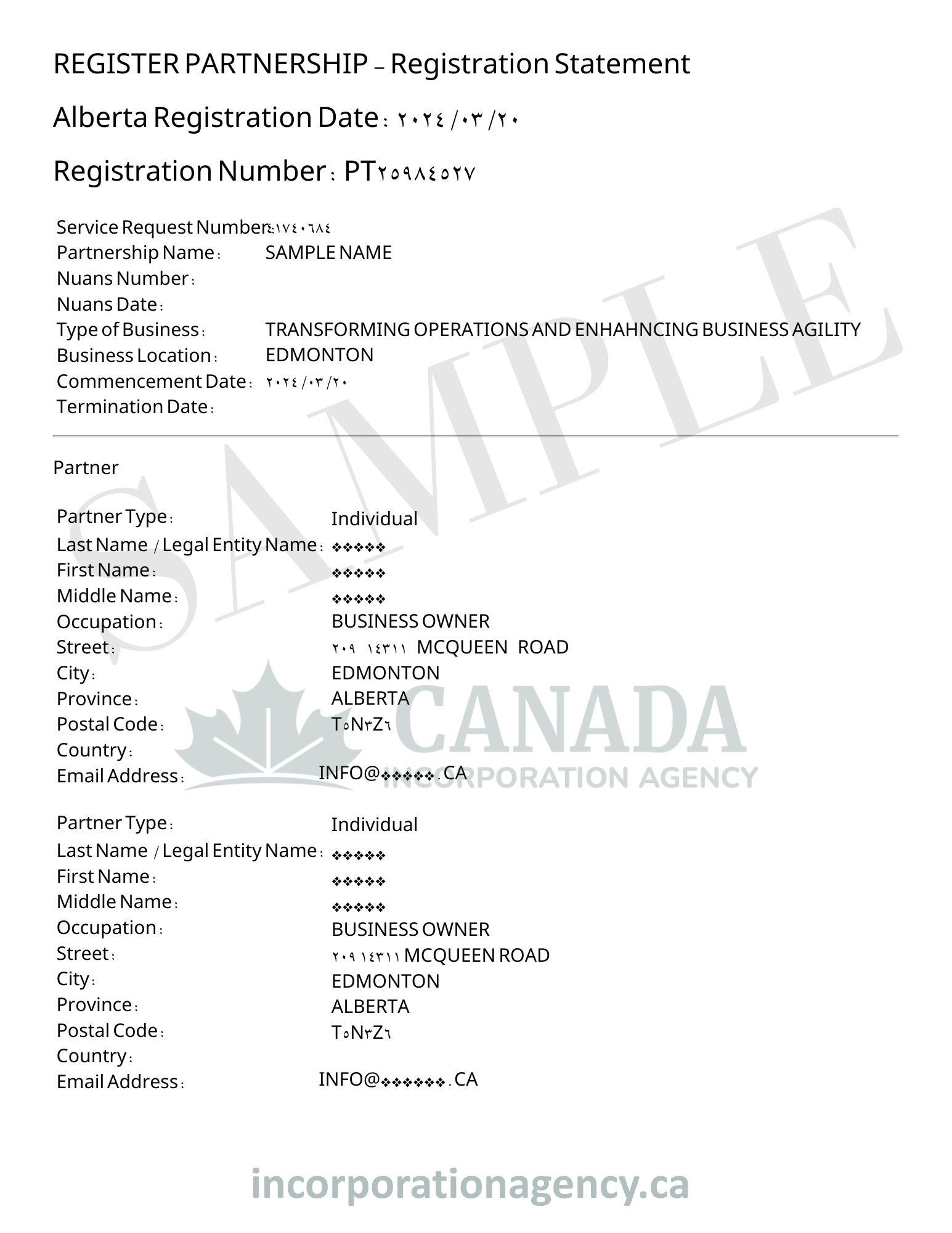
If you are planning to Register a Partnership in Alberta, make sure you start with a clear, well-structured partnership agreement. Once you’re ready to formalize your business, Business Alberta Online provides the fastest, safest, and most Alberta-focused registration service available.